VR, AR and MR Explained: What Sets the Technologies Apart – and How Do They Work?

VR, AR and MR Explained: What Sets the Technologies Apart – and How Do They Work?
Virtual Reality, Augmented Reality and Mixed Reality – three terms often used interchangeably, yet they describe very different technologies. What they share is a goal: to expand how we experience the world by blending the physical and the digital. But how do they actually work, and what makes them distinct? Here’s a clear guide to VR, AR and MR – and a look at how they’re being used across the UK today.
VR – the fully immersive experience
Virtual Reality (VR) is all about stepping into a completely digital world. When you put on a VR headset, you’re cut off from your physical surroundings and placed inside a fully simulated environment. The headset tracks your head and hand movements, allowing you to look around, move and interact with virtual objects as if you were really there.
VR is no longer just for gaming. It’s being used in a wide range of fields, including:
- Training and education – pilots, surgeons and emergency responders can practise in realistic but safe virtual scenarios.
- Architecture and design – buildings and interiors can be explored in 3D before they’re built.
- Therapy and rehabilitation – VR is used to treat phobias, PTSD and to support physical recovery after injury.
To deliver a convincing experience, VR requires powerful graphics, precise motion tracking and a headset capable of rendering movement without lag. It’s a technology that completely surrounds the user – which is why it can feel both thrilling and intense.
AR – the digital layer on top of reality
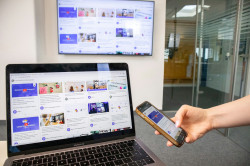
Augmented Reality (AR), as the name suggests, augments the real world rather than replacing it. It overlays digital elements – such as text, images or 3D models – onto what you see through a smartphone, tablet or AR glasses.
A well-known example is the mobile game Pokémon GO, where virtual creatures appear in real-world locations through your phone’s camera. But AR has many practical uses beyond entertainment:
- Navigation – arrows and directions can appear directly in your field of view.
- Education and culture – museums can use AR to show how historical sites once looked.
- Maintenance and industry – engineers can see step-by-step instructions projected onto machinery as they work.
AR doesn’t require expensive equipment – a smartphone is often enough. That accessibility makes it ideal for everyday use, where digital information enhances the physical world in simple, useful ways.
MR – when the real and the digital truly interact
Mixed Reality (MR) is the most advanced of the three. It combines elements of both VR and AR, allowing digital objects not just to appear in the real world, but to interact with it. MR relies on specialised headsets, such as Microsoft’s HoloLens, which map the environment in 3D and anchor virtual objects precisely within it.
Imagine standing in your kitchen and seeing a virtual instruction manual appear on the worktop, showing you how to assemble furniture – and it stays fixed in place as you move around. Or an architect walking through a construction site, viewing digital models integrated seamlessly into the physical space.
MR is already being used in:
- Research and development – to visualise complex data in 3D.
- Remote collaboration – colleagues can meet in a shared virtual workspace and manipulate the same digital objects.
- Education and simulation – students can interact with both physical and digital elements at once.
MR demands powerful hardware and advanced sensors, but in return it offers an experience where the boundary between real and virtual almost disappears.
The key differences at a glance
Although VR, AR and MR all involve digital experiences, they differ in how immersive they are – in other words, how much the digital world takes over your perception.
| Technology | What you see | Typical equipment | Common uses | |-------------|--------------|-------------------|--------------| | VR | Only the virtual world | VR headset | Gaming, training, simulation | | AR | The real world with digital overlays | Smartphone, AR glasses | Navigation, learning, entertainment | | MR | Real and digital worlds interacting | MR headset | Design, collaboration, education |
In short: VR takes you into a new world, AR adds a digital layer to the real one, and MR blends the two so they coexist and interact.
Læs også:


The future of immersive technologies
VR, AR and MR are moving rapidly from niche to mainstream. Headsets are becoming lighter, cheaper and more comfortable, while software is growing more sophisticated and realistic. In the UK, these technologies are already being explored in sectors from healthcare and education to retail and tourism.
As they continue to evolve, the lines between them may blur even further – perhaps one day we’ll simply talk about “extended reality” as a single, unified concept. Whatever we call it, one thing is certain: the way we experience and interact with the world is changing, and VR, AR and MR are at the forefront of that transformation.
Læs også: